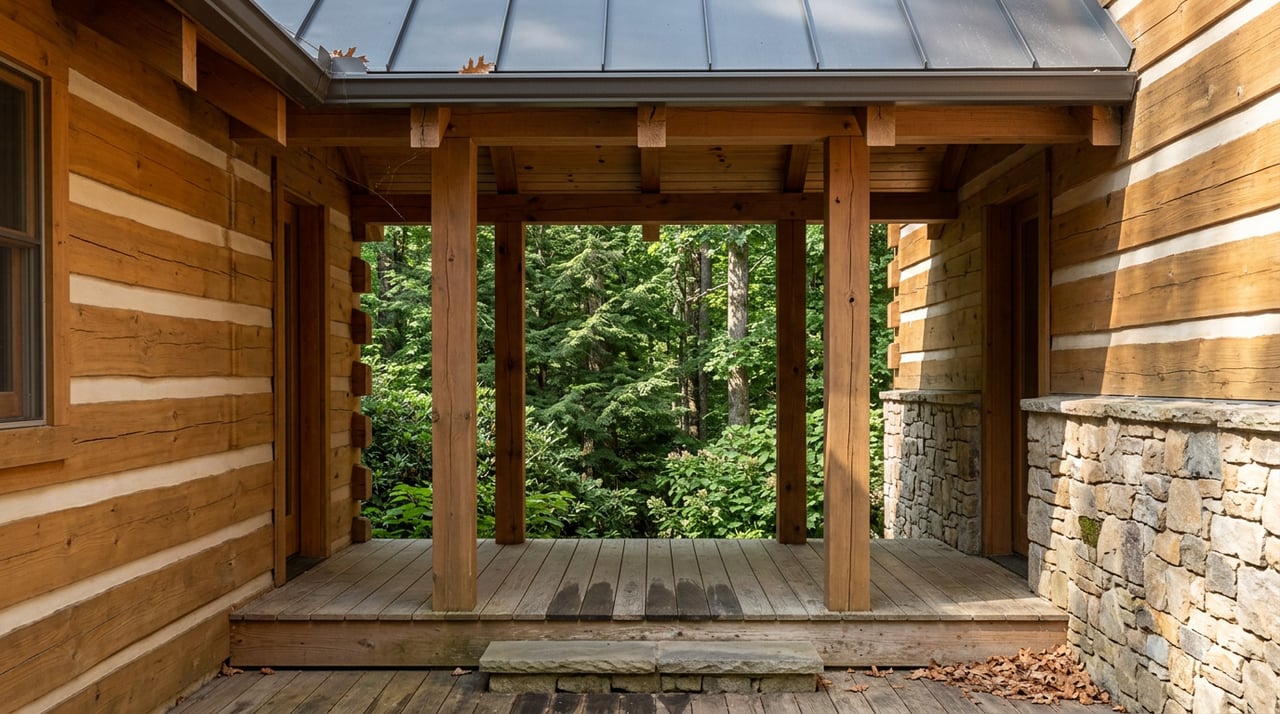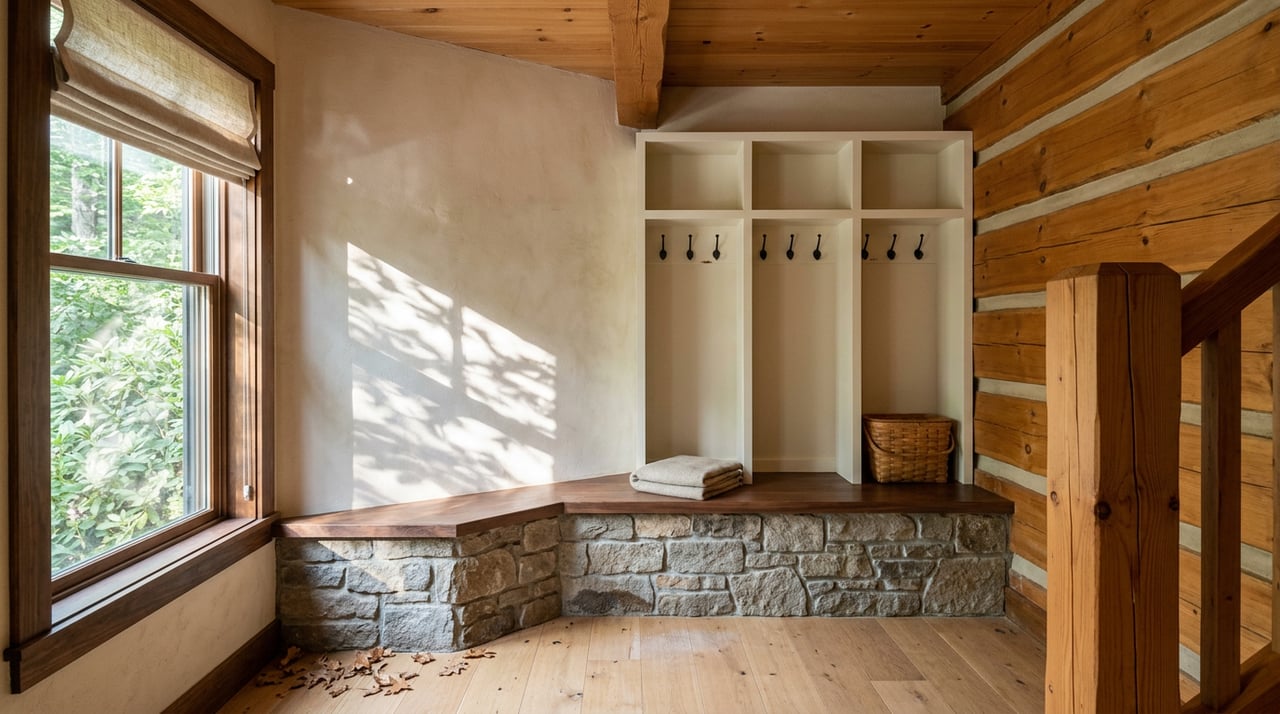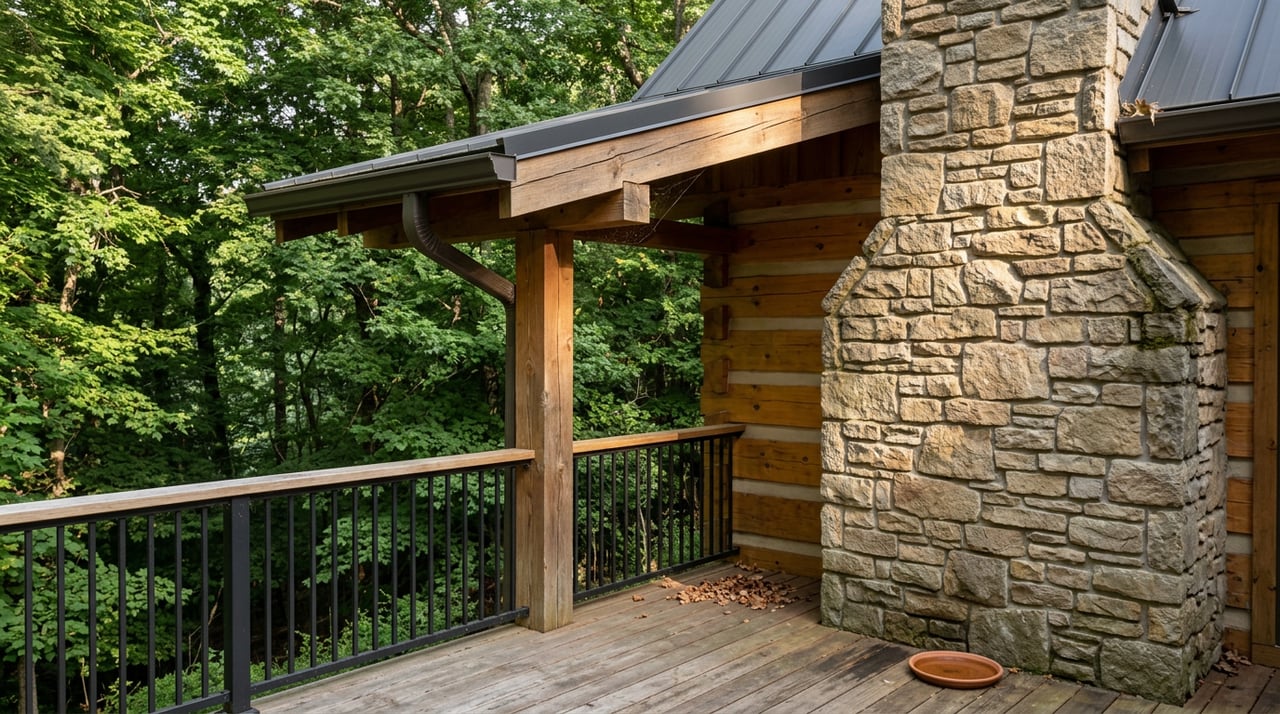

A buyer flew in last spring to tour two three-bedroom cabins about a mile apart on the east side of town. Same bedroom count, same deck orientation, same honey-log exterior, list prices within $18,000 of each other. One was a working short-term rental. The other, the seller swore, "could easily be one." The seller was not lying. The seller was also not right. One parcel sat in a zone that allows a Tourist Residency Permit. The other sat in R-1A, and no permit would ever be issued there.
That is the friction Gatlinburg's portals don't surface. Two cabins can look identical in every photograph and produce entirely different investment math because the numbers that matter most are the zone stamp on the parcel and the owner-occupancy status of the buyer. Sticker price is the last input, not the first.
The zoning stamp that ends the deal before it starts
Gatlinburg permits short-term rentals in R-1, R-2, R-3, C-1, C-2, tourist commercial, and mixed-use zones. It prohibits them in R-1A and R-2A. That distinction is not softened by a variance process, a grandfather clause a listing agent references in passing, or the fact that neighbors on adjacent parcels are already renting. A cabin sitting in R-1A cannot legally hold a Tourist Residency Permit, which is the credential every listing on Airbnb or Vrbo inside city limits is supposed to display.
The permit itself is inexpensive. $200 for a unit with two bedrooms or fewer, plus $75 for each additional bedroom, with an annual fire and safety inspection attached. Properties over three stories or sleeping twelve or more guests trigger sprinkler requirements. Penalties for operating without a permit reach $50 per day per violation, and Tennessee's three-strikes rule under T.C.A. § 13-7-604 lets the city permanently revoke rental rights after three documented violations for noise, trash, or occupancy.
None of that is the trap. The trap is that the eligibility question gets answered at the Gatlinburg Building and Planning Department at (865) 436-7792, not on the listing page, and not always by the listing agent. A buyer who writes an offer without confirming the zone is buying a residence, not a rental asset. In this market, that is a completely different product with a completely different valuation.
The practical rule is inverted from how most out-of-state buyers approach the search. Verify the zone. Then look at the price.
The 25% to 40% shift most pro formas miss
Assume the zone clears. There is still a line in the underwriting that almost every out-of-market spreadsheet gets wrong.
Under Tennessee's Short-Term Rental Unit Act, a property used as a short-term rental that is not the owner's primary residence, and that carries a business license, is reassessed from the 25% residential assessment ratio to the 40% commercial assessment ratio for property tax purposes. The millage rate does not change. The assessed value does. On the same cabin, the tax bill can jump materially the year after a non-owner-occupied buyer closes, even though nothing about the structure has changed.
This is where the tax line on the MLS sheet becomes actively misleading. That number reflects the current owner's status. If the current owner uses the cabin as a primary residence, or does not run it as a permitted short-term rental, the buyer inherits the property tax bill for about six weeks. Then the assessor's records catch up. The reset is not aggressive enforcement. It is the statute working as written, and it is the single most common reason a first-year cash flow projection misses.
A buyer modeling a Gatlinburg cabin should ask two questions before accepting a seller's tax figure. First, is the seller occupying it as a primary residence? Second, does the seller hold both a Sevier County business license and a City of Gatlinburg business license alongside the Tourist Residency Permit? The answers dictate whether the printed tax figure is the buyer's tax figure or a placeholder.
What the seasonality curve is actually telling you
Every Gatlinburg data provider agrees on the shape of the year. They disagree on the amplitude, and the disagreement matters.
| Month | Rabbu avg monthly revenue | StaySTRA avg revenue | StaySTRA occupancy |
|---|---|---|---|
| July | $7,372 | $6,618 | 80.7% |
| October | $5,405 | $6,538 | 77.4% |
| December | not published | $5,295 | 61.3% |
| February | $2,038 | $2,421 | 35.7% |
| January | not published | $2,716 | 35.5% |
Rabbu's data set, as of April 27, 2026, puts the July-to-February spread at roughly 3.6x. StaySTRA's March 2026 data set puts October slightly ahead of July and January and February close to identical. AirROI's June 2026 read pegs the median Gatlinburg listing at $4,222 per month, with top-decile listings above $10,720. Airbtics reports a $64,000 median annual revenue at 65% occupancy across 1,780 active listings as of March 2026.
The absolute numbers do not agree because the sampling doesn't agree. What every source agrees on is the trough. For roughly two months of the year, a Gatlinburg cabin can be expected to sit empty more nights than it is booked. Any pro forma that models the market as a smooth annual average is quietly under-reserving for the trough and over-crediting the mean.
The interpretive move for a buyer is to underwrite February, not the average. If the property covers debt service, cleaning, management, utilities, and the higher commercial-basis tax bill during a $2,400 revenue month, it can be run without stress. If the model only works at $5,300, the buyer is buying a peak-season asset and calling it an annual one.
Forward booking curves offer a partial counterweight. StaySTRA data shows 62.3% of available nights booked one to three months out and 73.3% booked seven to nine months out, which means guests plan Smokies trips early and operators who list early can hold price. Late repositioning, on the other hand, has limits. This is not a market where a January pricing correction rescues a January cash flow.
The comparison, sharpened
Return to the two cabins on the east side of town. The one in R-1 with a current Tourist Residency Permit and a non-primary-residence seller comes with a predictable tax basis, a permit the buyer can renew, and a booking history the buyer can inspect. The one in R-1A, priced $18,000 lower, cannot be rented at all inside the current ordinance framework. Its true comparable is not the R-1 cabin next door. Its true comparable is a Gatlinburg residence with no rental use case, priced against a very different pool of buyers.
Redfin's data for the three months ending May 2026 shows Gatlinburg selling at a median of $600,000 with homes averaging 62 days on market, down from 86 the year before, at a competitiveness score of 8 out of 100. That is a market with room to negotiate, not a market where buyers are shut out of due diligence. Zillow's ZHVI for Gatlinburg sits at $506,638 as of late May 2026, down 6.9% year over year. The point is not which index is right. The point is that a buyer has time. There is no reason to skip the zone verification, the permit review, or the assessor question because a listing feels urgent.
A short pre-offer checklist
- Ask the listing agent for the parcel's zone designation, then verify it directly with the Gatlinburg Building and Planning Department at (865) 436-7792.
- Ask for the current Tourist Residency Permit number and confirm it is active.
- Ask whether the seller occupies the cabin as a primary residence. If not, request the last full year of property tax bills.
- Ask for booking history broken down by month, not annual gross.
- Underwrite February revenue against fixed costs including the reassessed tax figure.
FAQ
If the parcel is R-1A, is there any path to renting it? Not as a short-term rental of stays 89 days or fewer inside Gatlinburg city limits. The ordinance excludes R-1A and R-2A without a permit pathway. Longer-term leasing follows separate rules.
Does the commercial reassessment apply if I plan to use the cabin part of the year myself? The classification hinges on whether the property is the owner's primary residence. Occasional personal use of an otherwise short-term-rented, business-licensed property has historically triggered the 40% assessment. Confirm your specific situation with the Sevier County Assessor before closing.
Are the STR rules likely to change? Regulatory posture in Gatlinburg has been stable from 2024 through mid-2026, with no aggressive enforcement sweeps reported and Tennessee state law preempting local outright bans. Stability is not permanence, but the direction of travel has been consistent.
If you are weighing two cabins and want a second read on the zoning, the permit, or the tax basis before you write, Deana Dellinger will pull the parcel record and walk the numbers with you. Get Your Free Home Valuation to start the conversation with a working file, not a guess.