If you own a Sevierville cabin, you know that rental income is a big part of its value. Buyers here are not just buying wood and stone, they are buying proven cash flow in a tourism market. When you use rental data the right way, you can price with confidence and defend your number to both lifestyle buyers and investors.
This guide shows you how to use trailing‑12‑month revenue, cap rates, GRM, price‑per‑bedroom, and amenity premiums to price a short‑term rental cabin in Sevierville. You will also get a clear checklist to verify your numbers and present them well. Let’s dive in.
Why rental income changes pricing
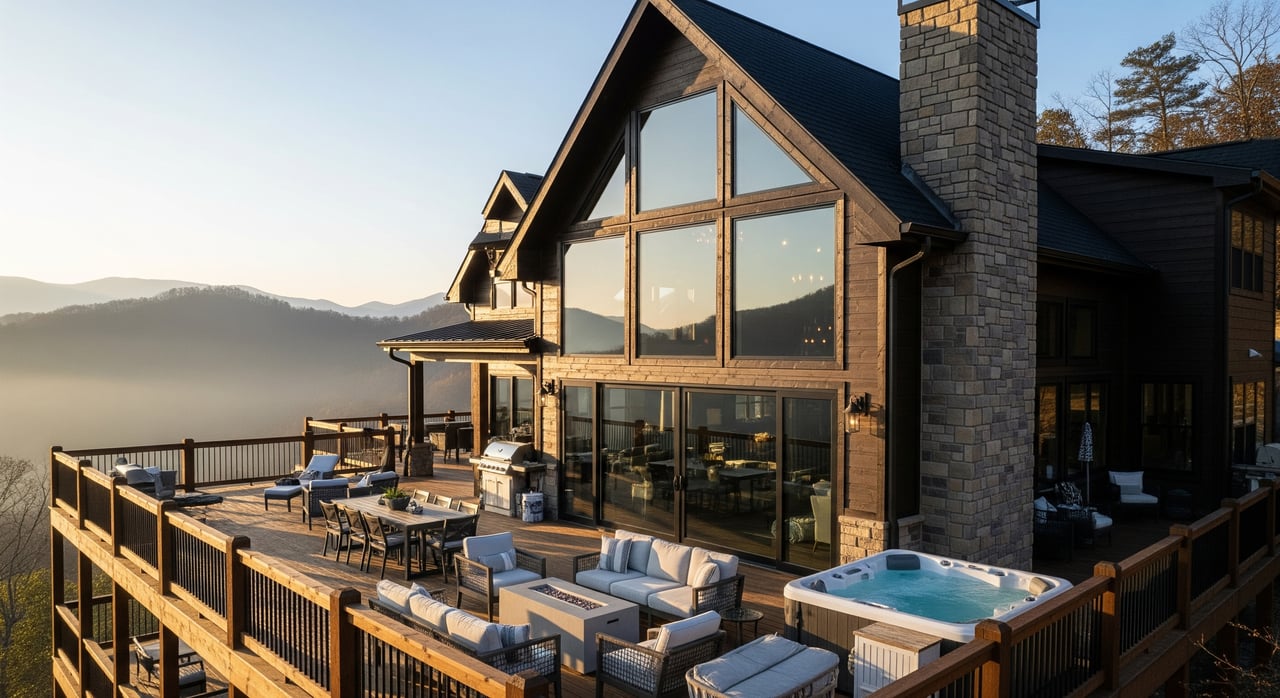
Sevierville sits at the gateway to Great Smoky Mountains National Park with quick access to Pigeon Forge and Gatlinburg. That location creates strong seasonality, high peak‑season nightly rates, and event‑driven occupancy spikes. Many cabins are purpose‑built for short‑term rentals with hot tubs, game rooms, views, and family‑friendly layouts.
Because of this, buyers often price based on income rather than only on square footage. A cabin with verified rental history and solid operating margins can command a premium over a similar non‑rental home. To capture that value, you need clean, verifiable data and the right methods.
Start with verified T12 revenue
Your trailing‑12‑month revenue, or T12, is the foundation. Collect it, verify it, then normalize it.
- Gather owner payout statements, platform transaction histories, bank deposits, and any channel manager reports.
- Pull occupancy tax filings to support gross revenue.
- Handle cleaning fees consistently. If fees are included in owner payouts, include them in gross and note your fee structure.
- Account for owner use. Subtract lost revenue for owner nights, or report both actual and a normalized pro forma that assumes full availability.
Normalize unusual events so buyers can trust the number.
- Remove one‑time spikes, like a large, non‑repeat group booking.
- Note extraordinary dips, like a repair shutdown.
- If a new manager improved performance, present historical results and a pro forma to show the trend.
Present both your actual T12 and a normalized version with a short explanation. That transparency builds trust and reduces buyer discounts.
Convert T12 to NOI the right way
Net Operating Income, or NOI, is what investor buyers care about. It is your gross rental revenue minus operating expenses, not including mortgage payments or income taxes. For Sevierville cabins, be thorough and realistic.
Include typical expense lines such as:
- Management fees, often 10 to 30 percent depending on self‑management vs professional.
- Utilities that you pay, like electric, water, internet, and trash.
- Insurance with short‑term rental endorsements.
- Repairs and routine maintenance, plus supplies and linens.
- Platform or channel fees, and any marketing costs.
- HOA dues if applicable, and property taxes.
- A reserve for replacements, often 5 to 10 percent of revenue.
Use actual invoices and agreements whenever possible. If you lack a full year of expenses, use market‑based ratios and note your assumptions. Clear backup helps investors underwrite faster and with fewer price chips.
Cap rate method for investor pricing
The cap rate method ties value directly to income. The basic relationship is simple: Cap Rate equals NOI divided by Price. You can also solve for a price using Price equals NOI divided by Cap Rate.
Apply it in four steps:
- Verify your T12 and compute NOI after all operating expenses.
- Select a market‑appropriate cap rate using local sales of income‑producing cabins when available, then adjust for risk, location, property condition, and seasonality.
- Test a price range by running your NOI through a reasonable cap rate band.
- Compare the result to recent STR sales and to your GRM cross‑check.
Think about risk adjustments. Higher seasonality and uncertainty push cap rates higher, which lowers price. Verified bookings across multiple channels, strong repeat guests, and professional management can support lower risk and a lower cap rate.
A simple sensitivity check helps you and your buyer get aligned. Show implied price at a conservative, base, and optimistic cap rate. That gives investors a quick way to say yes without haggling over unknowns.
Example for method only: If your normalized NOI is 80,000 dollars and you are testing cap rates of 7.5, 8.0, and 8.5 percent, the implied price range is about 941,000 to 1,067,000 dollars. Always use cap rates supported by local STR sales and current market appetite.
Cross‑check with GRM
Gross Rent Multiplier, or GRM, is a fast screening tool when expense detail is thin. GRM equals Price divided by T12 gross revenue. It is useful when comparing cabins with similar operations.
- Use GRM to spot outliers and as a sanity check on cap rate results.
- Remember it ignores expense differences. A cabin with a private pool will likely have higher utilities and maintenance. GRM will miss that.
When you share your pricing logic with buyers, show both NOI and GRM views. It signals that you have done your homework.
Adjust comps for STR income
Traditional sales comps still matter, but you need to adjust them for rental performance.
- Prefer comps that were marketed and sold as income‑producing with documented T12.
- From those comps, extract implied cap rates or GRMs and use them to value your cabin.
- If only non‑rental comps exist, estimate potential T12 from market analytics, then convert that to a price using cap rate or GRM. Clearly label estimates versus verified numbers.
Classify your comps into three groups and act accordingly:
- Group A: Sold as STR with income disclosed. Compute implied cap or GRM and apply to your cabin.
- Group B: Sold as second home with no income. Estimate the income value gap and adjust.
- Group C: Sold as long‑term rental. Convert to an STR income proxy if layouts and locations align, or use cautiously.
This process helps you defend adjustments beyond simple price‑per‑square‑foot comparisons.
Price‑per‑bedroom, used carefully
Price‑per‑bedroom is a familiar Smoky Mountain heuristic. It can be helpful, but only within tight guardrails.
- Compare cabins of similar age, finish level, view quality, and amenity set.
- Remember that not all bedrooms are equal. Two master suites can outperform two small rooms.
- Sleeping capacity and bathroom count often correlate with revenue better than bedroom count alone.
Use price‑per‑bedroom as a quick benchmark, then check it against your income‑based value. If there is a wide gap, dig into amenity and layout differences.
Quantify amenity premiums
In Sevierville, amenities move the needle on nightly rate and occupancy. Avoid flat rules of thumb for features like hot tubs, views, game rooms, or pools. Instead, measure the revenue effect.
Try this three‑step approach:
- Build two comparable sets in the same micro‑area and season. One set has the amenity, the other does not. Keep bedrooms, quality, and photos as similar as possible.
- Compare ADR and occupancy over the same period. Focus on revenue per available night.
- Convert the net revenue lift to value. Use your target cap rate or GRM. If the amenity adds 8,000 dollars in annual net revenue and your target cap rate is 8 percent, the rough value lift is about 100,000 dollars. Subtract any added operating costs before converting.
Document your method and results so buyers can follow your logic. The clearer you are, the more likely you capture the amenity premium in your sale price.
Due diligence checklist for STR cabins
Gather a complete data package before you go to market. It builds credibility and speeds up underwriting.
- Income verification: platform statements, bank deposits, occupancy tax filings, and channel manager or PMS reports.
- Expenses: management agreements, fee schedules, utility bills, insurance policies, property tax bills, HOA rules and dues, maintenance logs, and reserves.
- Booking records: full T12 calendar, cancellation patterns, repeat guest rate, and channel mix.
- Compliance: city or county STR registrations if required and transient occupancy tax status. Confirm HOA restrictions or any pending changes.
- Physical condition: inspection for wear, safety items, and a detailed inventory of furnishings and equipment.
- Market risk: check for new supply in your micro‑market and stay aware of regulation or tax changes.
Having this in hand often tightens buyer cap rate expectations and supports a stronger price.
Presenting your value to the market
How you package the numbers matters as much as the numbers themselves. Speak to both investors and lifestyle buyers.
For sellers:
- Lead with verified T12 and a clear NOI.
- Show normalized performance and any growth drivers, like new photos, smarter pricing, or amenity upgrades.
- Provide a concise valuation summary with income approach, GRM cross‑check, and adjusted comps.
- Offer transition help, such as introductions to proven managers and a plan to honor future bookings.
For investors:
- Share source documents and a clean reconciliation of revenue to deposits and tax filings.
- Include a sensitivity analysis for ADR or occupancy dips, plus expense scenarios.
- Identify any deferred maintenance and propose reasonable holdbacks or credits so everyone can move forward quickly.
Simple pricing workflow
Use this quick process to set a defensible asking price.
- Verify your T12 and build a normalized version that explains anomalies.
- Build an expense schedule and compute NOI, including reserves.
- Select a realistic cap rate range based on local STR sales and risk.
- Calculate implied prices at each cap rate and pick a base target.
- Cross‑check with GRM from recent income‑producing sales.
- Review price‑per‑bedroom and amenity premiums for reasonableness.
- Package your data and listing materials so investors can underwrite in a single sitting.
When to call a local expert
Pricing STR cabins in Sevierville is part art, part math. You need local seasonality context, neighborhood nuance, and investor‑grade presentation. With deep experience in Sevier County vacation rentals, polished digital marketing, and a track record of successful sales, you can get both the story and the numbers right.
Ready to price your cabin with confidence or bring it to market with investor‑focused marketing? Reach out to Deanna Dellinger for a data‑driven valuation and a clear plan.
FAQs
What is T12 revenue for a Sevierville STR?
- It is your trailing 12 months of short‑term rental revenue, verified by platform statements, bank deposits, and occupancy tax filings, and adjusted for owner stays and anomalies.
How do I choose a cap rate for my cabin?
- Start with local sales of income‑producing cabins, then adjust for seasonality, property condition, booking diversification, management quality, and regulatory risk.
Should I use GRM or cap rate to price?
- Use both. Cap rate ties price to NOI and expenses, while GRM is a quick cross‑check based on gross revenue. Reconcile the two and explain differences.
How do I value amenities like a hot tub or view?
- Compare similar listings with and without the amenity, measure the net revenue lift, subtract added operating costs, then convert that lift to value using cap rate or GRM.
Can I price well without rental history?
- You can estimate using market analytics and adjusted comps, but verified T12 and a pro‑forma will produce more confident offers and a tighter cap rate range.
What documents will investors expect to see?
- T12 statements, bank deposit summaries, occupancy tax filings, a detailed expense schedule, booking calendars, management agreements, and proof of compliance with local rules.